Research & field translation

Science for society.

Water research, testing, diagnostics, and field deployment for safer communities.

Navmarg develops practical water-technology systems through applied chemistry, contaminant-removal studies, embedded diagnostics, geospatial mapping, and real field validation. The work is designed for laboratories, schools, communities, public agencies, and implementation partners.

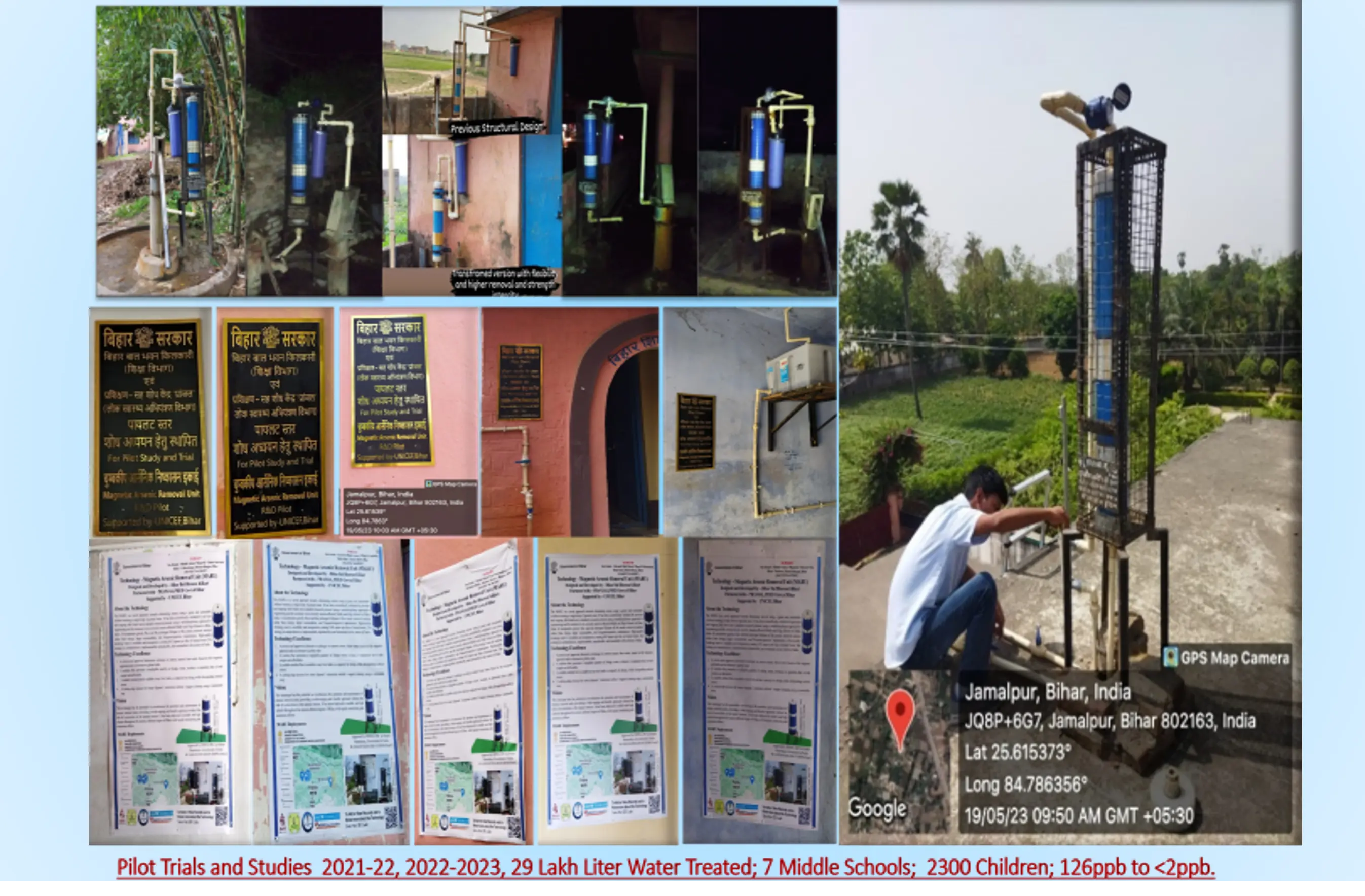
School children using a field-deployed drinking water treatment unit
Fieldvalidated learning
Science for societyResearch that reaches water points.Laboratory work is connected with field conditions, user needs, testing records, maintenance learning, and deployment evidence.
LabWater chemistry & testing
FieldSchool/community validation
GISWater intelligence mapping
IPPatents & technical records
Research areas

A water research platform, not a single-device page.

Navmarg’s research work is organized around clear scientific domains, practical testing, prototype development, and field translation.

H₂O

Water Treatment Chemistry

Testing how groundwater chemistry affects contaminant removal, including pH, conductivity, turbidity, iron interference, arsenic species, and treatment stability.
As

Trace Metal Removal

Development of removal pathways for arsenic and other trace metals, keeping public communication focused on purpose, performance checks, and field output.

µC

Embedded Diagnostics

Sensor electronics, microcontroller-based measurement, calibration workflows, data logging, and field-ready water-quality monitoring hardware.

GIS

Geospatial Water Intelligence

Spatial contamination mapping, risk layers, hotspot identification, public-scheme monitoring, and decision-support dashboards for water governance.

Project portfolio

Projects are shown by purpose and output, not hidden technical IP.

Each project explains what the research is about and what practical output it is expected to deliver, without exposing unpublished invention details.

Magnetic Arsenic Removal ResearchPurpose: study arsenic-removal behaviour and translate it into safe drinking-water treatment hardware. Output: field-deployable treatment units, testing records, and maintenance protocol.
In-Situ Water Quality DevicePurpose: develop a field system for fast multiparameter water screening. Output: sensor-based device architecture, calibration workflow, and local reporting interface.
Geospatial Water IntelligencePurpose: make water quality visible like air quality. Output: maps, risk layers, hotspot dashboards, and planning tools for agencies and communities.
Arsenic Speciation StudyPurpose: compare measurable spectral and magnetic signatures of inorganic arsenic species. Output: research evidence for future rapid screening and sensing workflows.
Field Deployment ResearchPurpose: understand how systems perform in schools, communities, and public water points. Output: operational feedback, performance checks, user documentation, and scale-up learning.
Laboratory to field pathway

Research only matters when it survives outside the lab.

Navmarg follows a practical development route from problem definition to evidence, testing, field validation, and deployment documentation.

Problem definition

Identify contaminant type, water source, site condition, user need, and treatment objective.

Bench study

Run basic chemistry checks, water-quality screening, material response, and treatment-pathway comparison.

Prototype engineering

Convert the research idea into hardware, firmware, testing layout, or software workflow.

Testing & validation

Check performance using relevant water-quality parameters, repeat tests, and document evidence.

Field translation

Prepare deployment notes, maintenance logic, partner reports, and public-use documentation.

Facilities & laboratory capabilities

A credible research facility section for reviewers.

Add exact laboratory photographs, instruments, and partner names later. The structure below is ready for a serious research website and avoids unsupported claims.

Water chemistry

Applied Water Testing Bench

pH, EC, TDS, turbidity, baseline water-quality profiling, sample preparation, and comparative treatment checks.

Process study

Treatment Pathway Evaluation

Screening of treatment routes for metals and other contaminants using lab observations, repeat measurements, and field constraints.

Prototype

Fabrication & Assembly Area

Filter housings, flow components, mechanical layout, installation fitment, serviceability review, and field-ready assembly testing.

Electronics

Embedded Systems Desk

Microcontroller boards, sensors, signal acquisition, firmware testing, display interface, data logging, and device troubleshooting.

GIS

Geoscience & Mapping Workstation

Village-level mapping, water-source datasets, contamination-risk layers, spatial interpolation, and field survey visualization.

Field evidence

Deployment Documentation Cell

Pilot records, test reports, photographs, maintenance notes, user feedback, and technical files for partners and agencies.

Facilities, collaborations & field network

Built through labs, institutions, and real water points.

Use this section to list verified collaborations, facility access, field testing locations, academic support, and public-sector touchpoints.

Replace placeholders with exact facility photographs, MoU names, instrument photos, and partner logos only after confirmation.
Academic & research institutionsCollaborative research, technical validation, literature support, instrumentation access, and scientific review.
Government and field departmentsPublic-water problem identification, field locations, community feedback, deployment records, and scheme-level requirements.
CSR and implementation partnersPilot deployment, school/community reach, operational feedback, and scale-up planning for safe-water systems.
Laboratory and testing supportWater-sample testing, method selection, quality checks, repeat measurement, and comparison with recognized standards.
Reference library

Standards, agencies, and scientific references used for research direction.

These are common water-quality and environmental references. They open only when clicked, in a new tab, and are not loaded inside this page.

Testing methodsAPHA / AWWA / WEF Standard MethodsReference source for water and wastewater examination methods used by laboratories and researchers.Open reference →
Public healthWHO Drinking-Water Quality GuidelinesInternational public-health reference for drinking-water safety, risk management, and guideline values.Open reference →
Analytical methodsUS EPA Drinking-Water Analytical MethodsApproved analytical-method references for drinking-water monitoring and laboratory method selection.Open reference →
Indian standardsBIS Standards Search PortalIndian Standards portal for searching drinking-water and environmental testing references.Open reference →
India authorityCentral Pollution Control BoardEnvironmental regulatory information, water-quality resources, and pollution-control references in India.Open reference →
Water governanceJal Jeevan MissionReference context for rural drinking-water supply, public infrastructure, and reporting.Open reference →
WASHUNICEF Water, Sanitation & HygieneReference for safe-water access, community health, sanitation, and public-impact framing.Open reference →
Water educationIHE Delft Institute for Water EducationWater education, applied water research, and sector capacity-building reference.Open reference →
Chemical databasePubChemChemical information source for compound data, identifiers, molecular structures, and reference chemistry.Open reference →
Arsenic backgroundArsenic in the EnvironmentReference background for arsenic occurrence, exposure, and environmental distribution.Open reference →
Removal reviewTechnologies for Arsenic Removal from WaterReview-style reference for arsenic-removal technologies, limitations, and future perspectives.Open reference →
Magnetics modellingFEMM Permanent Magnet ExampleReference context for finite-element magnetostatic modelling and magnetic field simulation.Open reference →
Research record

IP, publications, reports, and technical documentation.

This section should present only public-facing records. Sensitive geometry, unpublished mechanisms, detailed formulas, and application-drafting content should not be exposed on the website.

Add public PDFs, patent links, publication links, and field reports here after checking that each file is safe for website release.
Patent recordMagnetic filtration device for arsenic removal from drinking water

Public-facing description only: research translated into arsenic-removal hardware for drinking-water applications.

Research paperMagnetic-field-assisted arsenic removal study

Early scientific work documenting the direction of magnetic-field-assisted contaminant-removal research.

Technology fileWater-quality device and field diagnostics documentation

Device architecture, sensor workflow, field reporting logic, and validation documents for reviewer use.

Presentation packageDeployment evidence and safe-water impact records

Slides, site photographs, water-testing summaries, beneficiary records, and partner-facing technical notes.

Data layerWater-quality mapping and geospatial intelligence records

Village/site datasets, map layers, contamination-risk analysis, and planning outputs for water-governance use.

For reviewers, labs & collaborators

Bring a water problem. We map the science, testing route, and field path.

Navmarg’s research page gives funding agencies, technical reviewers, laboratories, and implementation partners a clear map of the company’s R&D capability without repeating the About page.

Start a research conversation